
Tarteel vs tajweed is one of the most common points of confusion for anyone learning Quran recitation — and the short answer is that they are not the same thing. Tajweed is the set of technical rules for pronouncing each letter correctly, while tarteel is the Quranic command to recite in a slow, clear, and reflective manner. Ask any student who has spent a few months learning Quran recitation, though, and you’ll get a different answer every time — some say the two words mean the same thing, others say tajweed is the technical part and tarteel is “just reading slowly.” Neither answer is quite complete.
Understanding the difference between tarteel and tajweed isn’t just a vocabulary exercise — it changes how you actually practice. In this guide, we’ll break down what each term really means, how they relate to each other, a full list of tajweed rules, and how you can start applying both correctly, whether you’re just starting out or trying to refine years of recitation habits.
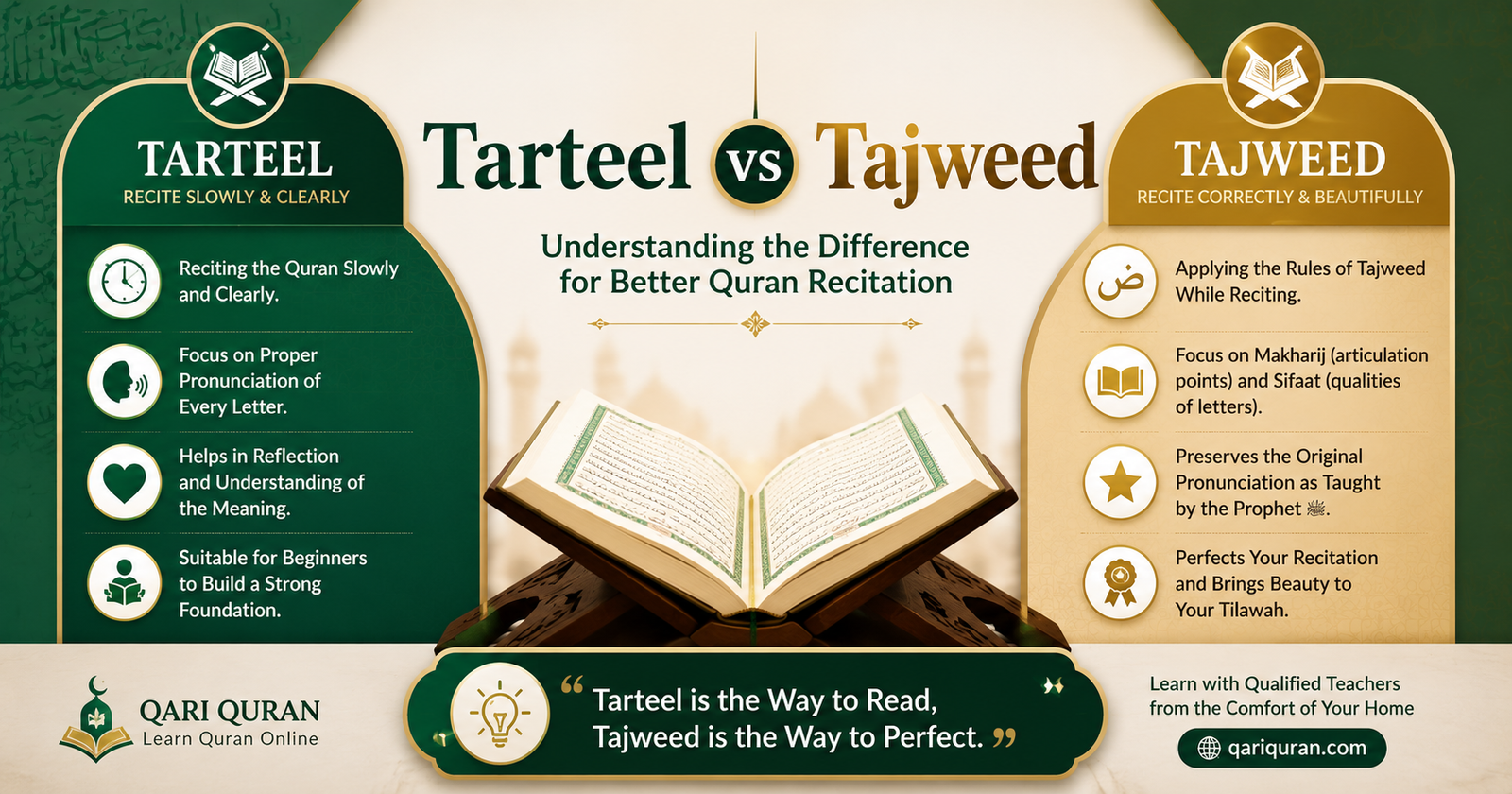
Table of Contents
What is Tajweed?
So, what is tajweed? In simple terms, tajweed is the set of rules that govern how each letter of the Quran should be pronounced. The word comes from the Arabic root jawwada, meaning to perfect, refine, or bring something to excellence. When people ask “what is tajweed in Quran” studies, they’re really asking about the science that protects the Quran’s pronunciation from drifting or being distorted over time. For a deeper dive, see our full guide on what is tajweed (internal link).
A proper tajweed definition covers several interconnected areas:
- Makharij al-Huruf — the exact articulation point of each Arabic letter (throat, tongue, lips, etc.)
- Sifat al-Huruf — the characteristics that distinguish similar-sounding letters from one another
- Madd — rules of vowel elongation and how long each stretch should be held
- Ghunnah — the nasal sound that accompanies certain letters
- Idgham, Ikhfa, Iqlab, Izhar — the rules that govern what happens when noon sakinah or tanween meets another letter
- Qalqalah — the slight bouncing or echoing sound produced on specific letters
In other words, tajweed rules are less about “style” and more about accuracy. Either a letter is pronounced from its correct point of articulation, or it isn’t. This is exactly why tajweed can be taught, tested, and corrected — and why it’s genuinely difficult to master from a book or app alone. A teacher needs to hear you recite and point out what your tongue is actually doing, not what you assume it’s doing. This technical precision is the first half of the tarteel vs tajweed picture — the second half is about how that precision is delivered.
What is Tarteel?
Tarteel meaning in English is often reduced to “reciting slowly,” but that’s only part of the picture. The word comes from the Arabic root ratala, which carries the sense of things being well-ordered, evenly spaced, and free from being crowded together.
Applied to Quran recitation, tarteel means reciting in a measured, unhurried, and clear manner — giving each word its rightful time, pausing where appropriate, and allowing space for reflection on the meaning of what is being recited. It’s not simply about slowing your tongue down; it’s about making sure your understanding keeps pace with your recitation.
This is precisely why tarteel meaning in Arabic carries more weight than a simple translation like “slowness” suggests. A person can technically read very slowly while their mind is elsewhere entirely — and that isn’t tarteel either. True tarteel combines pacing, clarity, and presence of heart. Keeping this in mind is essential before comparing tarteel vs tajweed side by side, since the two terms are measuring completely different things.
Tarteel vs Tajweed: Quick Comparison Table
Here’s a side-by-side look at the difference between tarteel and tajweed:
| Aspect | Tajweed | Tarteel |
|---|---|---|
| What it is | A body of technical pronunciation rules | A manner of reciting commanded in the Quran |
| Root meaning | j-w-d — to perfect, to excel | r-t-l — to be ordered, evenly spaced |
| Main question it answers | “Am I pronouncing this correctly?” | “Am I reciting this the way it was meant to be received?” |
| Focus areas | Makharij, sifat, madd, ghunnah, idgham, ikhfa | Pace, clarity, pauses, reflection |
| Learned through | Study plus correction from a qualified teacher | Habit, deliberate pacing, and repeated practice |
| Can exist without the other? | Yes — correct rules applied while rushing is common | No — mispronounced letters break tarteel by definition |
This table captures the core of the tarteel vs tajweed comparison, but the real value comes from understanding how the two actually interact — which is where most beginners get confused.
The Quranic Basis of Tarteel (Surah Al-Muzzammil 73:4)
Unlike tajweed, which developed as a formal science over generations of scholarship, tarteel is commanded directly in the Quran:”…and recite the Qur’an with measured recitation.” (Surah Al-Muzzammil, 73:4)
Classical commentators have unpacked this verse extensively. The general consensus is that the command isn’t only about tempo — it’s about pronouncing letters clearly, giving vowels their proper length, and allowing the reciter and listener to actually absorb the meaning rather than letting the tongue outrun the mind. This is also the verse most scholars point to when explaining that tajweed, as a discipline, ultimately serves the goal of tarteel — a relationship that sits at the heart of the entire tarteel vs tajweed discussion.
Tajweed Rules Explained (Complete List)
If you search “tajweed rules” or “rules of tajweed,” you’ll find dozens of scattered lists. Here’s the core rule categories every learner needs, organized the way a real tajweed course teaches them — from foundational to advanced. This section also covers all tajweed symbols and the characteristics of letters (sifat) that appear on every mushaf. Knowing these rules in detail is the technical foundation you need before the tarteel vs tajweed relationship makes practical sense.
Makharij al-Huruf (Articulation Points)
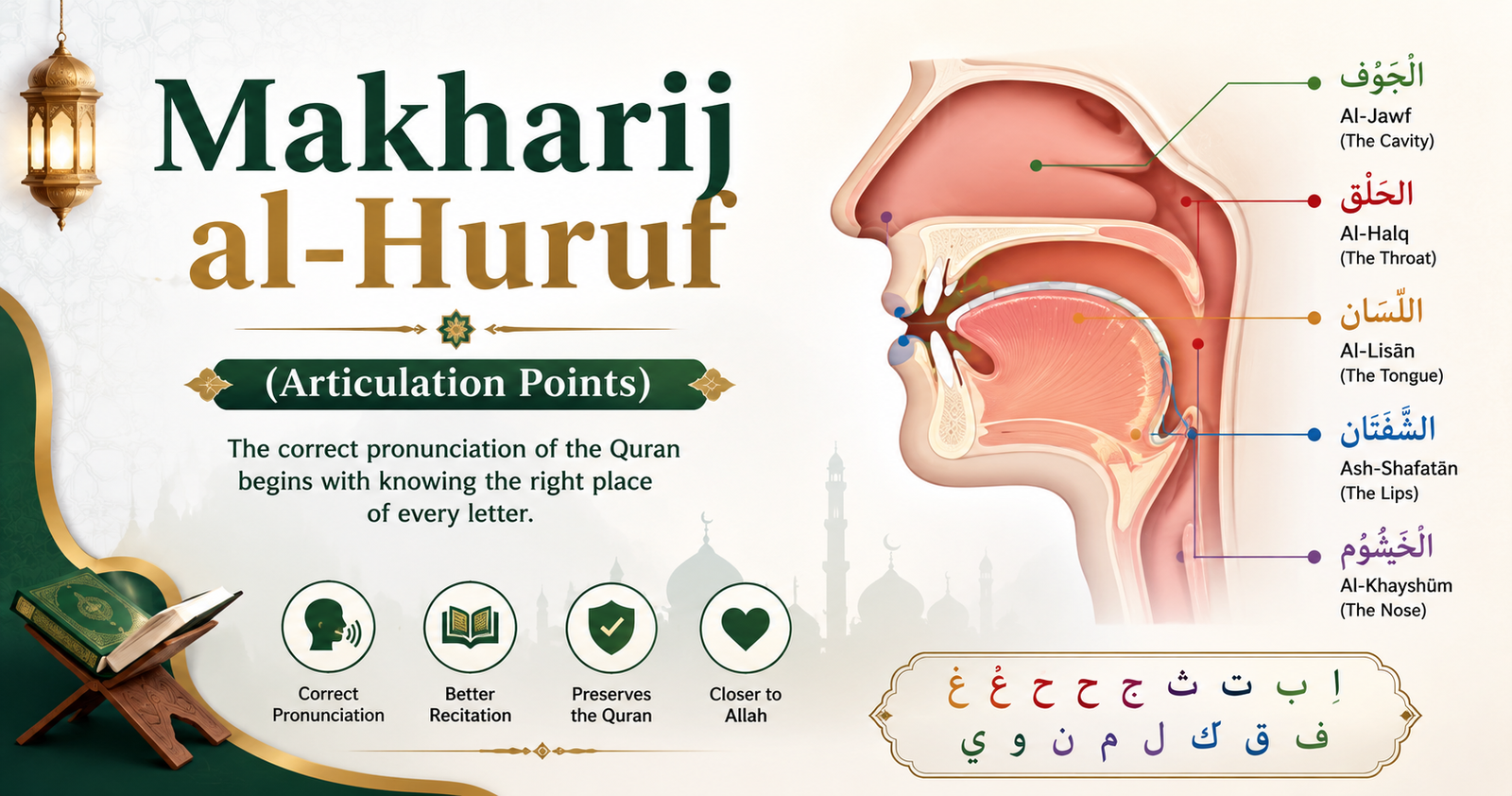
Every Arabic letter originates from a specific point in the mouth or throat — the lips, the tip of the tongue, the middle of the tongue, the throat, or the nasal cavity. Getting the makhraj wrong is one of the most common reasons two different letters end up sounding identical.
Sifat al-Huruf (Characteristics of Letters)
Beyond where a letter is produced, sifat describes how it’s produced — whether the sound is heavy (tafkheem) or light (tarqeeq), whispered or voiced, and whether airflow is blocked or continuous. This is what allows a trained reciter to tell apart letters that come from the same articulation point.
Noon Sakinah and Tanween Rules
When a silent noon or tanween meets certain letters, one of four things happens:
- Izhar (clear pronunciation) — the noon sound stays fully clear
- Idgham (merging) — the noon sound merges into the next letter
- Iqlab (flipping) — the noon sound is converted into a meem sound
- Ikhfa (concealment) — the noon sound is partially hidden with a nasal tone
Meem Sakinah Rules
A silent meem follows a similar but separate set of rules depending on the letter that follows it, including its own version of ikhfa and idgham.
Madd (Elongation Rules)
Madd governs how long a vowel sound is held — measured in counts (harakat). Different situations call for different lengths, from the natural 2-count madd to extended 4- or 6-count madd when specific letters follow.
Ghunnah (Nasalization)
Ghunnah is the nasal resonance that must accompany certain letters, most notably noon and meem when doubled (with a shaddah) or in specific idgham and ikhfa situations.
Qalqalah (Echoing/Bouncing Sound)
Qalqalah applies to five specific letters when they carry a sukoon — producing a slight bounce or echo in the sound rather than a flat stop.
Waqf and Ibtida (Rules of Stopping and Starting)
Knowing where you’re permitted to pause and where you must continue is its own category of tajweed rules, since stopping in the wrong place can distort the meaning of a verse.
Together, these categories make up what most people mean when they refer to tajweed rules of the Quran — and mastering them in this order (articulation → characteristics → noon/meem rules → madd → ghunnah → qalqalah → waqf) is the most efficient learning path.
A Short History of Tajweed
Tajweed as a formally documented science emerged after the Quran had already been preserved through oral transmission for generations. As Islam spread beyond native Arabic speakers, scholars recognized that pronunciation mistakes were becoming more common among new reciters, and they began systematically recording the rules that earlier generations had absorbed naturally by listening and imitating.
This is also where the different types of tajweed styles come from — regional recitation schools developed slightly different conventions for pacing and rule application, though the underlying pronunciation rules remain consistent across all of them. Understanding this history helps explain why tajweed is taught as an oral, teacher-led discipline rather than something learned purely from a written rule book.
How Tajweed and Tarteel Work Together
A helpful way to think about it: tajweed is the technical layer, and tarteel is the outer framework that holds it. You cannot achieve genuine tarteel while mispronouncing letters — that would break the very clarity tarteel demands. At the same time, you can apply every tajweed rule with textbook precision while still rushing through the page and absorbing nothing, which is tajweed without tarteel. This is the practical, working answer to tarteel vs tajweed: not a competition, but two layers of the same complete recitation.
A student who wants a complete recitation combines both:
- Tajweed rules to keep the pronunciation accurate and the meaning protected from distortion.
- Tarteel pacing to keep the recitation reflective, unhurried, and spiritually present.
Most structured quran tajweed lessons actually teach the rules first, since correcting pronunciation habits early prevents them from becoming permanent. Tarteel is then trained as a recitation style once the letters themselves are reliable.
Common Misconceptions About Tarteel and Tajweed
A few habits of thought keep beginners confused about tarteel vs tajweed for longer than necessary:
- “Tarteel just means reading slowly.” Slowness is a symptom of tarteel, not its definition. You can read slowly with your mind elsewhere and still miss the point entirely.
- “Tajweed is a phase you complete.” In reality, tajweed rules apply to every recitation you’ll ever do — including your daily salah — not just a course you finish and move past.
- “A beautiful voice replaces the need for tajweed.” Vocal beauty sits on top of accurate pronunciation; it doesn’t substitute for it.
- “They’re basically the same word.” They describe two different layers of the same act — one technical, one experiential — and confusing them leads students to neglect one while over-focusing on the other.
Tarteel vs Tajweed vs Qira’at vs Tilawah
Since these four terms often appear together, a quick clarification helps:
- Tajweed — the rulebook for correct letter pronunciation.
- Tarteel — the commanded manner of reciting: measured, clear, and reflective.
- Tilawah — the general act of reciting or reading the Quran aloud, without specifying style or technique.
- Qira’at — the different authenticated modes/readings of the Quran (such as Hafs or Warsh), which is a separate branch of Quranic sciences involving textual transmission, not pronunciation technique.
Understanding the difference between tajweed and qirat in particular avoids one of the more common beginner mix-ups: qira’at is about which authenticated reading is being followed, while tajweed is about how that reading is correctly pronounced. Once these four terms are separated clearly, the tarteel vs tajweed question stops being confusing and becomes just one small piece of a much bigger picture.
Why Tajweed is Important in Quran Recitation
The importance of tajweed in the Quran comes down to preservation of meaning. Arabic is a language where a single mispronounced letter or missed elongation can genuinely change the meaning of a word. Reciting without tajweed rules risks distorting the very text believers consider to be the literal word of Allah.
There’s also a well-known hadith often cited on the importance of tajweed: the one who recites the Quran proficiently and correctly is described as being among the honorable, obedient scribes — while even someone who struggles through it with difficulty is still rewarded for the effort. This is frequently referenced when discussing the importance of tajweed in Urdu-language study circles as well, where the emphasis is placed on protecting the wording from distortion (lahn) rather than achieving perfection instantly.
Scholars generally treat learning the rules that prevent meaning-altering errors as obligatory for anyone with access to proper instruction, while treating the more advanced refinements of style as recommended rather than mandatory. This is another reason the tarteel vs tajweed distinction matters practically, not just academically — one protects the words, the other protects the meaning behind them.
How to Learn Tajweed and Tarteel (Step-by-Step for Beginners)
If you’re wondering how to learn tajweed as a complete beginner — including for non-Arabic speakers just starting with basic tajweed — here’s a practical starting sequence:
- Start with letter articulation (makharij). Before touching full verses, learn where each Arabic letter is produced in the mouth and throat. This is the foundation everything else builds on.
- Learn the noon and meem rules. Idgham, ikhfa, iqlab, and izhar appear constantly in the Quran — mastering these early prevents dozens of recurring mistakes.
- Add madd (elongation) rules. Learn the different categories of madd and their correct counts, since incorrect elongation is one of the most common beginner errors.
- Practice with short surahs first. Apply the rules to short, familiar chapters before moving to longer passages — this keeps corrections specific and manageable.
- Introduce tarteel deliberately. Once your letters are reliably accurate, slow your pace further than feels natural, and start reading the meaning of what you recite so your understanding keeps up with your tongue.
- Get corrected by a live teacher. This is the step self-study can’t replace — you can’t hear your own ikhfa or hidden mistakes objectively, no matter how good the app or book is.
This sequence works whether you’re focused on learn tajweed quran study for personal practice or looking to teach tajweed to your own children at home — and it’s the most reliable way to put the tarteel vs tajweed relationship into daily practice rather than just theory.
5 Practical Tips to Improve Both
Once you understand the tarteel vs tajweed distinction, these habits help you apply it consistently:
- Record yourself weekly. Mistakes that feel invisible in the moment are often obvious on playback.
- Slow down more than feels comfortable. Most people who think they’re reciting slowly are actually at a moderate pace with a few pauses.
- Read the translation before you recite. Tarteel requires the meaning to be within reach — you can’t reflect on words you don’t understand.
- Fix one rule at a time. Trying to correct every mistake simultaneously usually fixes none of them.
- Prioritize accuracy over melody. A beautiful voice is welcome, but it should sit on top of correct pronunciation, not replace it.
Frequently Asked Questions
Is reading Quran without tajweed wrong?
Reading without the core rules that prevent meaning-altering mistakes is generally discouraged and, according to most scholars, considered an error that should be corrected. Minor stylistic refinements are more flexible, but foundational accuracy is not optional for those who have access to learning it.
Do you have to read Quran with tajweed?
Scholars distinguish between rules whose neglect corrupts meaning (which should be learned and applied) and finer points of refinement (which are recommended but not obligatory). In practice, most teachers encourage learning at least the essential rules as early as possible.
How many types of tajweed are there? T
ajweed isn’t divided into a fixed “number of types” so much as categories of rules — articulation points, letter characteristics, elongation (madd), nasalization (ghunnah), and the rules governing noon sakinah and meem sakinah (idgham, ikhfa, iqlab, izhar), along with qalqalah and rules of stopping (waqf).
What is the difference between tajweed and qirat?
Qira’at refers to the different authenticated modes of reading the Quran, passed down through unbroken chains of transmission, while tajweed refers to the pronunciation rules applied within any given reading. They operate at different levels entirely — one is about which version of the reading is used, the other about how it’s pronounced correctly.
Which should I learn first — tajweed or tarteel?
They aren’t strictly sequential. Tajweed is studied as a subject with a teacher, while tarteel is something you practice in every recitation from your very first lesson, even as a beginner.
Is tarteel vs tajweed the same as fast vs slow recitation?
Not exactly. Speed is only one visible symptom of tarteel, not its definition. The real tarteel vs tajweed distinction is between a set of pronunciation rules (tajweed) and a commanded manner of reciting with clarity and reflection (tarteel) — pace is just one part of the second.
What are the tajweed symbols in the Quran?
Most modern mushafs mark tajweed rules with color-coded symbols above or below the Arabic text — such as small circles for madd, colored letters for ikhfa or idgham, and specific marks for qalqalah. These color-coded copies are often called “tajweed Qur’ans” and are commonly used as a visual aid for beginners.
Conclusion