
There’s a moment that many pilgrims describe in almost the same words. It’s night in Makkah, the courtyard of Masjid al-Haram is full, and the imam begins to recite. The voice carries across the marble, thousands of people stand in silence, and a verse you’ve heard all your life suddenly sounds completely new.
For anyone who loves the Quran, praying behind the imams of the two holy mosques is one of the great gifts of a pilgrimage. And it’s open to everyone. You don’t need an expensive trip to stand in those rows. Even the cheap umrah packages many UK firms offer put you within reach of the Haram for every prayer. This article looks at the tradition of recitation in Makkah and Madinah, why it moves people so deeply, and how improving your own recitation before you travel can make your Umrah or Hajj far richer.
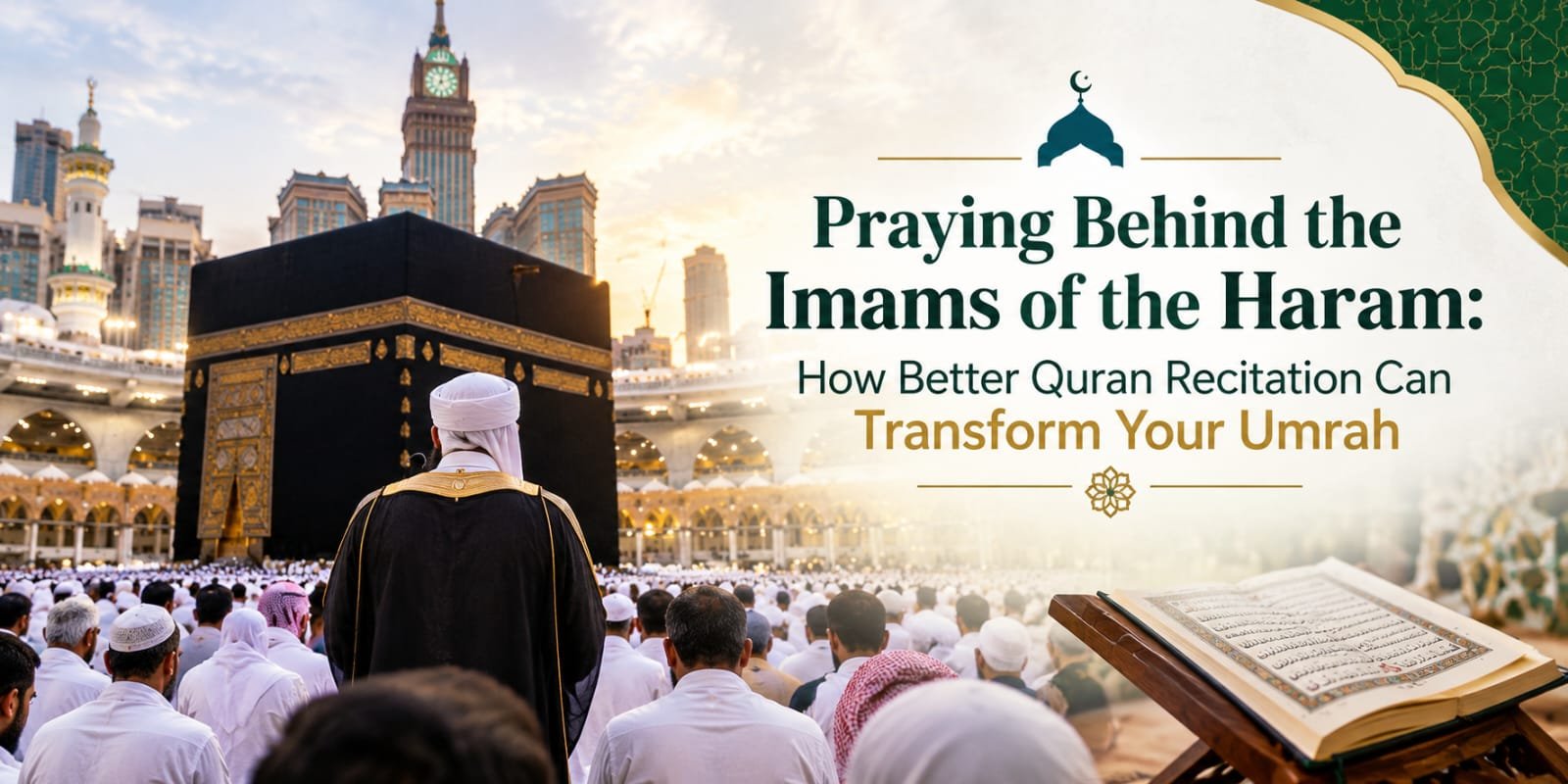
How can Quran study improve your Umrah?
- Correct recitation of Surah al-Fatiha and short surahs makes every prayer at the Haram more meaningful.
- Understanding the meaning helps you stay present during long night prayers.
- Listening to the imams of the Haram before you go helps you follow their recitation.
- Reading the passages about Ibrahim and the Kaaba connects the rituals to their story.
- Starting around three months before travel gives you time to make real progress.
Why is recitation at the Haram so special?
The imams who lead prayers at Masjid al-Haram in Makkah and the Prophet’s Mosque in Madinah are chosen for their knowledge, memorisation and beauty of recitation. Their voices reach millions of people, not only those in the mosque but also those watching the live broadcasts around the world. Names such as Sheikh Abdul Rahman Al-Sudais, Sheikh Maher Al-Muaiqly and Sheikh Yasser Al-Dosari are familiar to Muslims in Britain who have never set foot in Makkah.
In Ramadan, the imams aim to complete the whole Quran over the month in the Taraweeh prayers. Many pilgrims say that hearing an entire surah recited in that setting helped them understand it in a way that years of reading at home never did.
What is recitation like in Madinah?
The Prophet’s Mosque in Madinah has its own long tradition of recitation, and many pilgrims find its atmosphere especially gentle. The night prayers there feel calmer than in Makkah, and the slower pace makes it easier to sit and listen. Madinah is also where much of the Quran was revealed in the later years of the Prophet’s life, and reading those surahs in the city where they came down adds another layer of meaning. If your trip includes both cities, try to notice how the recitation feels in each.
Why does your own recitation matter?
At the Haram, you’ll pray many times, including the two short rak’ahs after Tawaf, which you usually pray on your own. Most of the time, you’ll be reciting Surah al-Fatiha and the short surahs you know best. If your recitation is hesitant or you’re unsure of the meaning, it’s easy for the moment to pass without much reflection.
Working on your recitation before you travel means that when you’re finally standing in front of the Kaaba, the words flow, you understand them, and your attention can stay where it belongs.
A 12-week Quran plan before your trip
Here’s a simple plan you can follow with a Quran teacher or on your own.
| Weeks before travel | Quran focus | Why it helps |
| 12 to 9 weeks | Correct Surah al-Fatiha and short surahs with a teacher | You’ll recite them in every prayer at the Haram |
| 8 to 6 weeks | Learn the meaning of the surahs you pray with | Makes your prayer more present |
| 5 to 4 weeks | Read the passages on Ibrahim and the Kaaba, with tafsir | Connects the rituals to their story |
| 3 to 2 weeks | Listen to recitations by the imams of the Haram | Helps you follow the long night prayers |
| Final week | Revise and choose a surah to recite at the Kaaba | Gives you a personal goal for the trip |
Weeks 12 to 9: get the basics right
Book a few sessions with a qualified teacher to check your recitation of Surah al-Fatiha and three or four short surahs. Small corrections in tajweed, such as the length of a vowel or the sound of a letter, make a big difference.
Weeks 8 to 6: learn the meaning
Read a reliable translation and short tafsir of the surahs you pray with. Knowing what you’re saying turns recitation into conversation.
Weeks 5 to 4: read the story of the House
The Quran describes Ibrahim and Ismail raising the foundations of the Kaaba and praying for it to be accepted, and the call to people to come on pilgrimage. Read these passages, especially in Surah al-Baqarah and Surah al-Hajj, with tafsir. When you walk between Safa and Marwa, you’ll remember that the Quran itself names them among the symbols of Allah.
Weeks 3 to 2: listen to the imams
Spend time listening to recordings of the imams of Makkah and Madinah. You’ll get used to their pace and style, and you may find you can follow along in the long night prayers more easily.
Final week: set a personal goal
Choose one surah, perhaps newly memorised, that you’d like to recite for the first time near the Kaaba. Many pilgrims find this becomes one of the most personal moments of the trip.
What about Hajj?
For those preparing for Hajj, the Quran is even more central. The Hajj rituals, from standing at Arafat to the sacrifice, are rooted in passages of Surah al-Baqarah and the surah named after the pilgrimage itself, Surah al-Hajj. Studying them with a teacher before you go gives every step a deeper meaning.
The practical side of Hajj has also changed. Hajj Packages from UK are now booked through Saudi Arabia’s official Nusuk Hajj platform. You register, wait to find out whether you’ve been given one of the UK’s limited places, and then choose and pay for a package within a short window. Hajj 2027 is expected around mid-May, depending on the moon sighting. Be wary of anyone offering a guaranteed place outside the official system.
Listening to the Quran during the trip
- Arrive early for Maghrib and Isha so you’re settled before the recitation begins.
- In Ramadan, stay for Taraweeh and, in the last ten nights, the late-night prayers.
- Keep a small Quran or a trusted app with a translation to follow along.
- Use quiet times after Fajr to read on your own near the Kaaba.
- Copies of the Quran are available on shelves throughout both mosques.
Helping children connect with the Quran on the trip
If you’re travelling as a family, the trip is a wonderful chance to inspire children in their Quran learning. Before you go, help them perfect one or two short surahs and explain their meaning. At the Haram, let them hear the imams recite those same surahs. Many children come home with a new enthusiasm for their Quran classes after hearing how beautiful the recitation can be.
Practical points before you travel
British passport holders can apply for a Saudi visa online. You’ll need a passport valid for at least six months from your arrival date, a meningococcal ACWY vaccination at least ten days before arrival, and an Umrah permit booked through the official Nusuk app. Book with a firm that holds an ATOL licence, which you can check on the Civil Aviation Authority website. Prices vary most with the time of year: Ramadan and the Christmas holidays cost the most, and quieter months usually offer better value.
Frequently asked questions
Do I need perfect tajweed to pray at the Haram?
No. Pray as well as you can. Improving your recitation before you go simply helps you feel more confident and present.
Who are the imams of Masjid al-Haram?
Several imams lead prayers, including well-known reciters such as Sheikh Abdul Rahman Al-Sudais, Sheikh Maher Al-Muaiqly and Sheikh Yasser Al-Dosari.
How early should I start preparing my recitation?
Around three months before travel gives you time to make steady progress with a teacher.
How do UK residents book Hajj?
Through Saudi Arabia’s official Nusuk Hajj platform.